
A Theory About Time, Economics and Measurement
Your existence as an exploited commons.

How much is a dog aware of time? Does he get any more bored looking out the window for two hours than he does for 30 minutes? Perhaps a little. But his response after either interval is the same. He will wag his tail just as vigorously either way. There is no signal intelligible to him that marks the passing of time, except the movements of the sun and moon, his digestion and the fading of certain strong smells.
Dogs perceive time, but they cannot meter it. A dog may hear a ticking clock, but he lacks the language skills to meaningfully keep track of how many ticks have passed. It is thought that most dogs can only count to 5.
Because of this, Dogs cannot make plans or co-ordinate at a distance. The dog’s realm is utterly immediate.
This does not mean that his being is any less real as our own, but it lacks the layer of language which fundamentally alters the human understanding of time vis-à-vis that of other animals and small children. Indeed, this is perhaps one of the most fundamentally unique things about adult humans, more unique than language itself: the ability to measure and experience precise intervals of regularised time.
This is not a new observation. The Ancient Greeks had two distinct words to describe the concept of time: Chronos (the time that ebbs away) and Kairos (Opportune or ‘right’ time). It is worth pointing out that Chronos is also the name of the God of Time, who tried to eat the Olympian Gods (his children). Later Christian writers would frequently associate Chronos with Satan. In some ways the Dharmic religions’ position that time is an illusion, the indigenous Australian concept of the Dreamtime and the Japanese concept of Satori (a moment of divine clarity which seems to last a fleeting instant and a long time simultaneously) are all getting at the same thing. There is a widespread human experience of a ‘Qualitative’ time that is outside of the domain of quantitative, metered Time. You might have heard this spun in a more new-age fashion as the idea of time-outside-of-time or the eternal-present. Some may find it gauche for me to say this, but you could argue that the concept of a flow-state is another example of exactly this idea. While writing this Essay I lost track of time completely…
What unites all of these concepts from across these different cultures is the idea that there are two types of time, that the unmetered one is where you feel most connected to your true being, and Chronos somehow getting in the way.
n.b. Heidegger probably would have something to say about this but I haven’t read Heidegger yet so I couldn’t tell you. If you know what Heidegger would have to say on the matter, please give your two cents (or his) in the comments!
This begs the question: How do I liberate as much time as possible from the influence of Time. Time qua The Eater of the Gods?
The key is to recognise that metered time can be traded. We trade our time all the time, both in the formal allocation of labour but also in the informal allocation of various kinds of commitments and social expectations too. It would be easy to lazily shout “Capitalism!” and be done with it, forgetting of course that Capitalism does not necessarily imply a higher level of commitment. Rich retired people under capitalism have perhaps the most time from time of anyone in history. The fact is that various external forces can place expectations upon the time of person, be they economic necessities and survival needs; kinship expectations; civic duties; personal drives; ambitions or desires. There is some sense that our participation in any system, even a Godly system, involves a sacrifice to Chronos the God Eater. He ate the Gods, and yet he also created them.
For the past year, I have engaged in a weekly audit to manage my approach to these systems. In the process, I have identified following list of systems that demand my time:
My wellbeing
My Home
My Work and side projects
My Social networks
My Partner
My Creative Endeavours
Meta-Strategy (The time it takes to co-ordinate all the above)
Other notable ones that people might experience could include children, a caring obligation, navigation of a disease or disability.
Each of these entities demands I commit some time to them. Some of this time is Kairos, the rest is Chronos. Since The Moment cannot be measured by its very nature, we have to use a rough proxy in order to evaluate how much of my time is given over to divine existence.
I Rank them Bronze, Silver and Gold. Bronze commitments are there to stop bad things from happening/maintain a status quo, from doing the dishes to turning up at work—these are the truest sacrifice to malevolent Chronos, necessary to placate His fury. Silver commitments are there to manufacture new possibilities—study, interesting pieces of work and projects, going to the airport, things that are unpleasant to do in the moment but necessary to make good things happen. Finally the golden activities are those which actually involve things I look forward to doing. The most likely candidates for encountering Kairos.
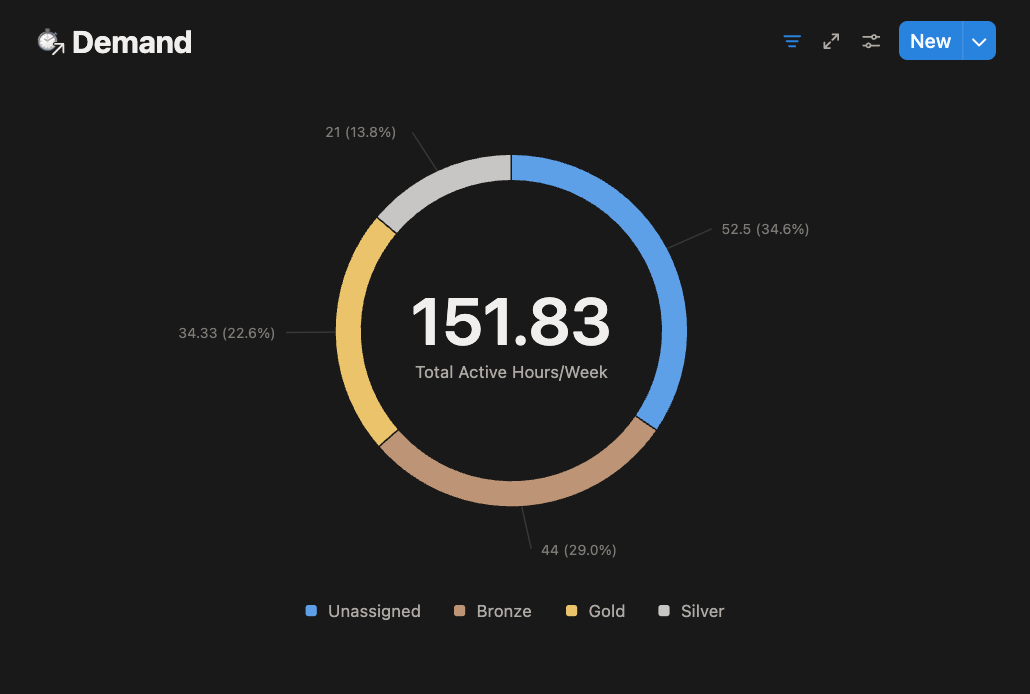
My maximal short-run utility would come from only doing things I want to do, however in the long run I may have to do things which are unpleasant in order to maintain access to the things that I want. Each of these systems is kind of like an economic agent, to sustain my participation within it, I must do certain things which are unpleasant, but this is necessary to sustain access to something I really value. For instance, if I refused to do my share of the chores, I would probably be able to spend less time enjoying the company of my partner, since she would be annoyed with me because the house is a tip. There is some cost, or tax that is necessary to sustain any relationship, be it with an organisation, another person or even with some aspect of yourself. In small quantities, these taxes are acceptable and sometimes even satisfying—in excess they can seem to sap away your very sense of who you are. Time eats your Gods.

It is therefore necessary, in a rather un-sexy grown-up sort of way to negotiate these somehow. As these relationships effectively commodify this metered chronos, it seems sensible that we might use the language of economics to see if we can ‘buy’ back some of our divine being, as Zeus rescued his kin from the belly of Father Time.
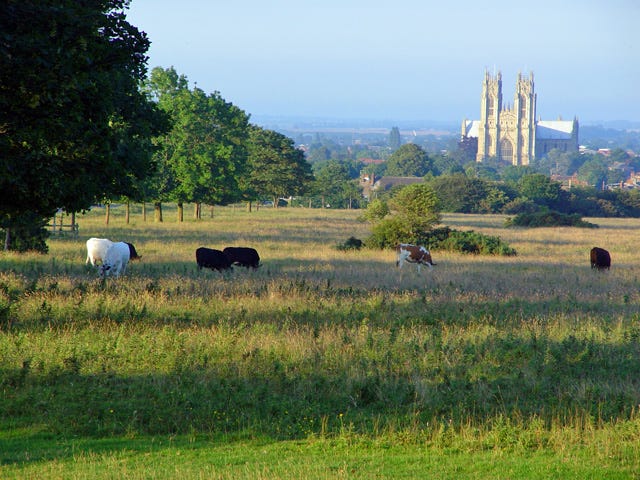
The Common Pasture was an area of land frequently found in Medieval England that was not under a single enclosed ownership. Any person could graze their cattle on the commons and it was no one person’s obligation to maintain or govern it directly, although it was nominally within the estate of a manor. Common pastures were a kind of Terra Nullius or no-mans-land. Anyone living in the area was free to make use of it. Most of them disappeared around the same time that the logic of modern empire was enclosing vast ‘Terrae Nullius’ at home and abroad, even though in both cases the land was not empty. That said, the imperialists were right about something: Common land tends to be economically inefficient.
This was noticed in 1833 when an academic called John Forster Lloyd performed a series of lectures on the fact that cows in common pasture were in poorer health than cows in enclosed estates. He noted that for each herder, the rational individual strategy is to graze as many cattle as you can afford to. However, since there is only so much grass, as more people pursue this strategy, grass is eaten faster than it can grow and everyone’s cows get skinnier and produce less milk. Individual short-run utility directly decreases collective utility and even the long-run utility of the individual, when his cows start to fetch lower prices at the market too.
The idea would remain fairly vague and obscure for a while until, over a hundred years later, in 1968 an economist called Garrett Hardin who was writing about human overpopulation gave it a name: “The Tragedy of the commons”. So it is with concepts, they can exist for a long time but until someone gives it a name and a discernible brand it remains something only half understood. Once the concept had a name and some modern academic weight behind it, it was applied to basically every issue where social science touches upon ecology: from overpopulation, to overfishing, deforestation, poaching and inaction on climate change. If there is some resource of uncertain ownership and multiple claimants, then the tragedy of the commons is likely to come up in conversation.
Indeed, aside from the law of diminishing returns, it is one of the few true laws of economics, that no-one would seriously argue doesn’t exist. If given the chance, people exploit things; if there are enough people, the thing degrades for everyone. Q.E.D. It is also unusual in the extent to which it invited a broad consensus across East and West throughout the duration of the cold war. Both Capitalist and Socialist economists tended to agree: the tragedy is real and Leviathan is the only way to stop it. That is why China instituted the One Child policy and the west legalised abortions. Either through coercive control or managed incentives: someone has to take ownership of the commons outright to prevent it from being destroyed. The only difference is whether the state controls it directly or parcels out enclosures to ‘rational private agents’.
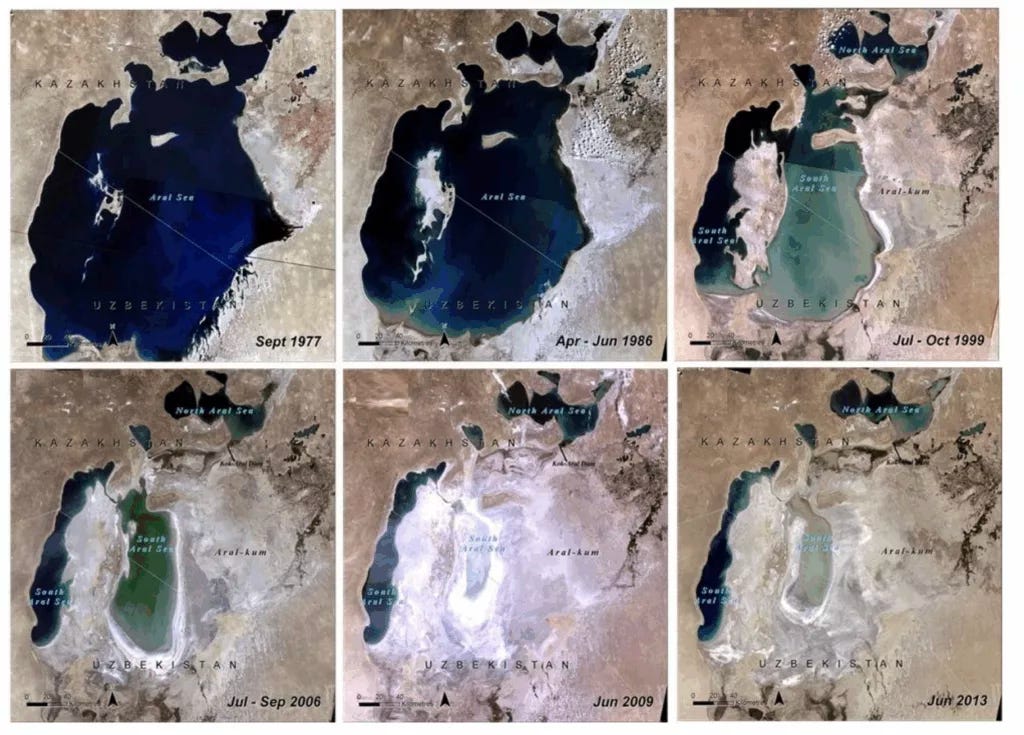
That said, more control is not necessarily a good thing. Because of its centralisation, state control can cause bad state decisions to compound and decrease the productivity of the entire economy. This was particularly true in socialist countries. During the great leap forward, the absurd steel quotas and adoption of Lysenkoism (a debunked ‘socialist’ science of agriculture) both worsened the worst famine in history and also made the soil less productive for several years after. The disappearance of the entire Aral sea was caused by wasteful Soviet irrigation projects, which increased short-run cotton production but caused the water to evaporate and never return.
And yet it can also be true that sometimes the state is the only suitable guardian, as is the case of fisheries, where it is impossible to carve out meaningful rights to any entity smaller than a nation-state because the assets don’t reliably stay in one place. Similarly, the reason why Arab countries have benefitted so mightily from their oil where African countries have suffered on account of their rare-earths is because Arab states have sufficiently coercive central powers to manage the development of their resources, a factor that is lacking in most post-colonial African states. Moreover, the major oil producers participate in OPEC, a cartel which limits its members production in order to artificially inflate the oil price (increasing long-term profits). This is something that can only happen if Oil companies are subordinate to the state (even if they are incredibly incestuously connected,) as opposed to the situation where the mining companies are not subject to any such constraint and can basically buy weak African governments outright.
Now, we cannot give all of our time over to an organisation to manage it for us. That is totalitarianism, and totalitarianism is not good. Handing over the management of our time to an external system can only end in our total subordination to it. The most common version of this is workaholism: where a person’s time is totally subordinated to the interests of ‘The Company’ meaning that they have no time to define their own reality or experience the fullness of life.
On the other extreme, asceticism is not appealing in the long run because it is vapid: by leaving our time completely undeveloped, we do not get to participate in any kinds of relationships or endeavours that permit deeper experience of The Moment—such as love, loss; accomplishment, loss; Creation.
Buddhism has a brief appeal to burnt-out people, but most of us aren’t Buddhas, I think most people need to have some kind of action. If you are Buddha natured, go and be a Buddha, and be contented in the fact you are correct: This is the only way to be truly free.
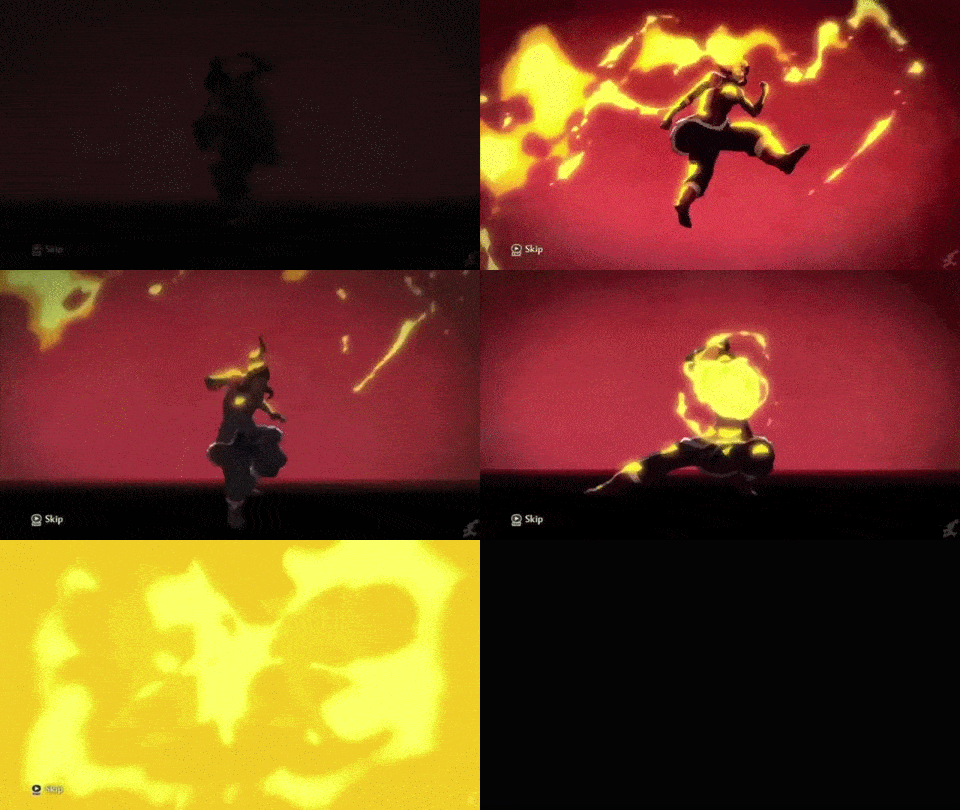
I am not Buddha natured, unfortunately. More of a Fire-bender to be honest.
For those of us who are not built for endless peace and tranquility, time is intractable, fundamentally difficult. There is no solution. P≠NP.
The only option is negotiation, acceptance, learning to navigate the composite nature of your time. Taking the time to identify how much of your time is commodified, and whether some of it could be taken off the market.
This could take a broadly Liberal view. If your time is a commons that can be parcelled into certain zones, with certain rights allocated, then it is possible to become your own leviathan. This is a functional technology for the management of this ‘time market’ — but it has the same problem of all market-based systems—by establishing firm property rights it reduces the immediacy of overproduction but it creates a situation in which the incentive towards maximum returns leads to the commodification of things which should not be commodified. This can be resisted for a time, but the temptation is there such that progressive concessions to demand lead to the erosion of the un-commodified surplus that we sought to protect, and we end up in a situation as oppressive as tyranny but with a more diffuse and resilient architecture of power. The Liberal political economy of time is hustle culture. Even if you are your own boss, you are still dedicating all of your time to your boss.
As such, we have to get even more unfashionable by getting even more centrist-dad about it:
Truly the only way is the unsexy, frictional and difficult work of self-governance, as expounded in detail by Elinor Ostrom’s Governing the Commons. The users of the commons must be engaged in some form of negotiation in order to both limit their individual propensity to maximise profit, and also to mutually enforce this contract, with mechanisms of enforcement to back this up. While some sort of recognised authority still has to exist as an arbiter, this authority is not given total domination over the space and rules according to the consent of the participants. You must surrender the idea that you are the total master of your own being, and embrace the fact that you share it with others and that the richest things in life come necessarily at the cost of a lot of busywork and drudgery.
We must be willing to share a little, and keep a little for ourselves.
We can also take solace in the fact that there are a few commons left in the world:
There are studies showing dogs can tell time by smell. They know when to expect their person (who comes and goes on a regular schedule) by how much their person’s smell has diminished in the home. If someone sneaks in with their person’s sweaty shirt in the middle of the day and waves it around, dog keeps napping when they normally would have known to come to the door before human returns.
Really like the article about time management. Well done