
As yet untitled
The Bureaucrat's long road to becoming

Spread thinner than an overpriced sandwich in a service station, every day carries with it the anguish of Dreams; multiple; that are in the process of becoming but are not quite there yet.
It shall be thousands of hours of toil before any one of them sees the light of day. Meanwhile I shall remain just-about-managing, disagreeable; occasionally a dick to people I love very much.
I am not afraid of the outcome anymore, it does not matter to me if nobody else can see the value of my work, it does not matter if I remain poor and disagreeable, if people laugh or take pity upon the results of my labours, if I keel over dead and penniless before getting where I need to go. For that reason, although the anxiety and the fear and the tiredness are very real, I am certain that the anguish of not doing these things would be all the more damaging to my personality.
As the Psychologist Marie-Louis von Franz observed: “People who have a creative side and do not live it out are most disagreeable clients. They make a mountain out of a molehill, fuss about unnecessary things, are too passionately in love with somebody who is not worth so much attention, and so on. There is a kind of floating charge of energy in them which is not attached to its right object and therefore tends to apply exaggerated dynamism to the wrong situation.”
In every area where I have made bad decisions, this has been the motivating factor. A charge of energy that has not been able to release itself, that has been stifled by a suffocating environment. I have made as good of an environment as I can within my means. A stable home, a decent enough income, an absence of stifling social pressures. That grants me the latitude to at least be aware of my despair, which as Kierkegaard pointed out, is the necessary first step to getting right with God—yet, in that despair I am aware of the great deal of work that lays ahead. Work that for a long time shall come without any material award.
So you see, it is absolutely necessary to seek the lesser of two madnesses. The madness of becoming, which is less than the madness of self-betrayal.
My only solace is in remembering the tenacity of those who came before. Of Franz Kafka and Henri Rousseau. Of men who struggled against the sapping madness of a life in the Bureaucracy by making art for its own sake.
Kafka never achieved fame over the course of his tragically short lifetime (He died of TB at 40), and yet his outputs are some of THE defining literary works of the 20th century. His ability to capture the alienating weirdness of modern life, be it through the weight of an ever-impending trial or the harrowing metamorphosis into a creature you do not recognise—makes his work a great sigh of relief to all who feel strangled by the onerous demands of an impersonalised social order.
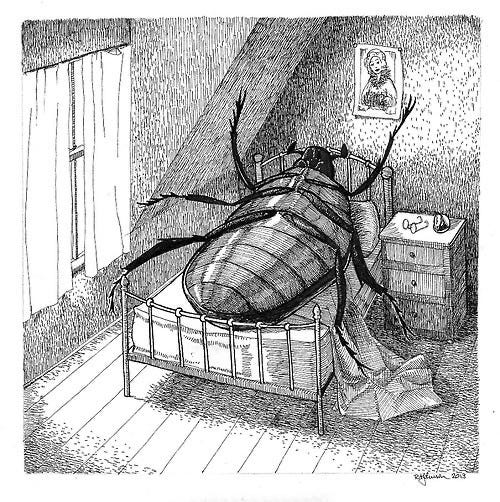
If Kafka described the crushing condition of being creatively inclined in the modern world. Rousseau lived the possibility of escape.
Just last week, I was brought to tears in an art gallery. Not by a piece that was intrinsically emotional, but because the context of the painting spoke to me on some deep level.
The painting in question was the Rousseau’s ‘landscape-self-portrait’, hanging in the Musée de l’Orangerie in Paris—a portrait of a man who did exactly what he set out to do, however long it took him to get there.
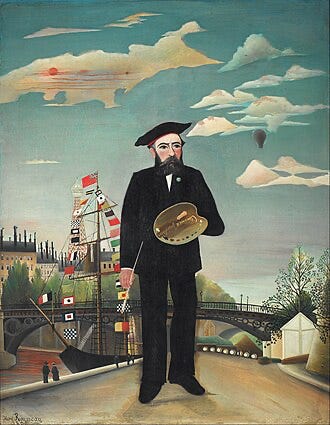
Rousseau, also known as ‘Le Douanier’ (the Tax Collector) was a man with no formal training, who, after a career in the state bureaucracy only really started painting seriously in his forties. During his lifetime, he was ridiculed by the critics for his childlike style but his work was reasonably commercially successful and presaged the development of many trends in modernist painting. Le Banquet Rousseau—a half serious, half jokey banquet held by Picasso in 1908, cemented him as an important figure in the Avant-Garde Canon. His jungle paintings, for which he is most famous, are beguiling windows into a world of pure imagination, exotic other worlds that he could only but dream of. (He never left France and never saw a jungle.)
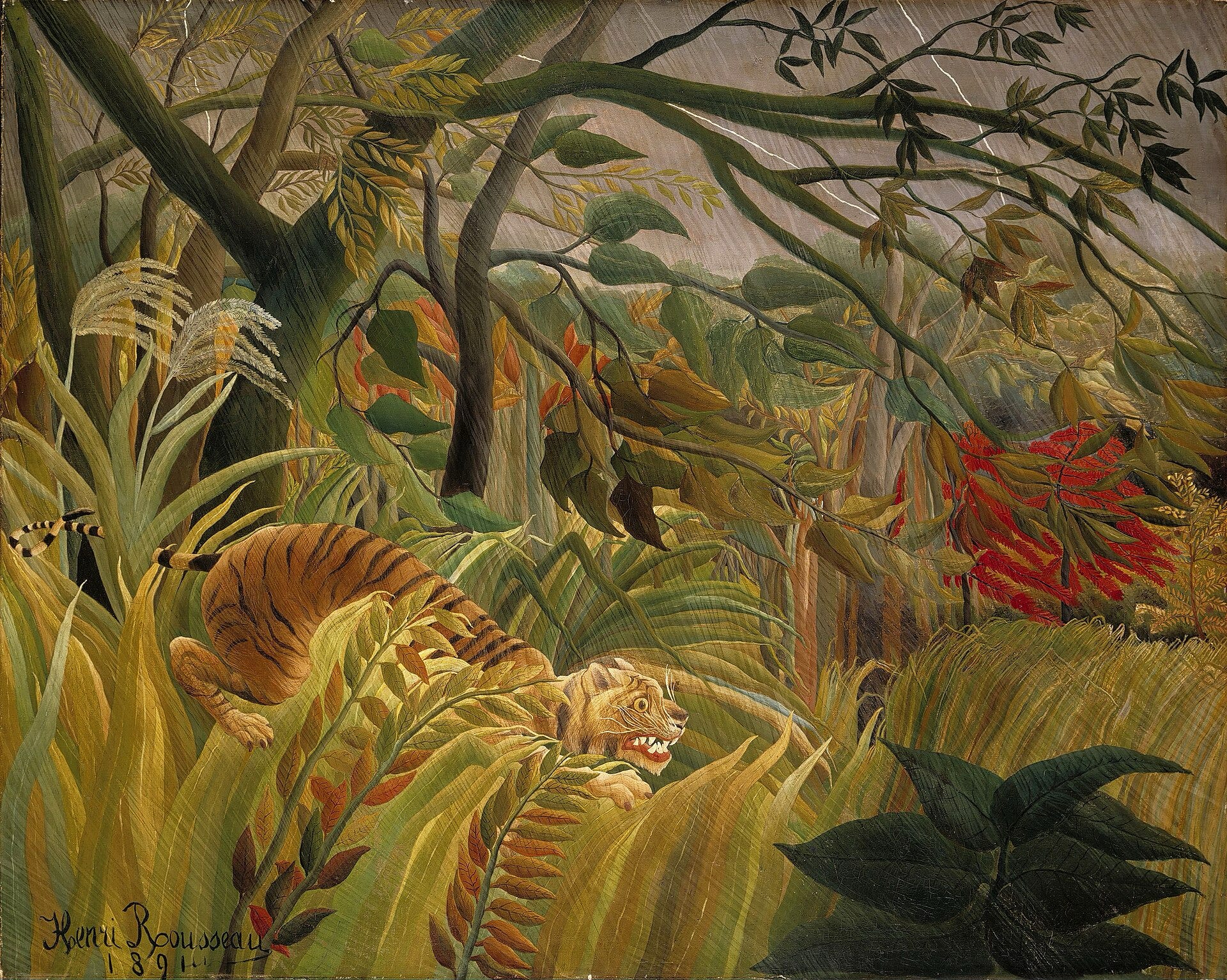
Kafka and Rousseau both had to work on their craft while also working in boring white-collar jobs. They didn’t have the privilege of means. They had to toil for a long time, in that state of terribly uncomfortable ambiguity between the creative potential, that floating charge of energy, and that need to make a living. Rousseau worked in the tax office for nine years while he was cultivating his craft in a studio in Montparnasse. Kafka never really had the opportunity of escape.
The great difficulty in this is that one has to let go of the possibility of a conventional career progression. To let go of the idea of status altogether, because status is a goal that naturally seeks the simplest pathway, which is never to pursue art. As responsibilities accrue, the space to make use of that charge of energy gets ever sparer. From the outside this can look like a kind of selfishness, and yet it is to prevent a far deeper defect of character that would amount from not pursuing that cause. This is what I’m having to figure out right now, how to move on from the idea of trying to struggle my way up the greasy pole of a job that serves only instrumental value, how to look beyond the pull of status, to do what I’m really here to do.
Most likely, I shall never make something of the same value as either of them, however their stories leave open the possibility that with enough perseverance I can make something that is at least true to my soul. That, at least, is my hope for now.
Excellent article Alex. Fully agree with your thoughts. You have our full support
You are welcome