
You can live 50% longer with this one weird trick | Here's what they don't want you to know
Notes on the perception of time.

I was recently stuck in an elevator for over an hour with a screaming eight-year-old. Aside from his proclamation that “We’re all gonna die!!!” and his promise that “I’m going to take the stairs for ever and ever, even to the top floor of Hamleys”, he also said something quite revealing about the perspective of a child: “What if they can’t get us out today and they have to come back to get us tomorrow what if we don’t survive until tomorrow because we starve? Its not fair, I’ve only had eight years!”
This speaks to something universal: when we are small we feel as though each day is a momentous occasion. I suppose that is why children hate to go to sleep, there is a finality about admitting that the day is ending. Even though healthy children do not tend to understand what death actually means, they frequently experience a kind of dread in the concept of the unconscious. To this little boy, the thought of tomorrow was so far away that he thought he might starve before it ever came.
The idea that time goes faster as you age is a well established one. Ceteris paribus, time ought to feel twice as fast when you are 32 as when you are 16 as when you are 8, since each given moment represents a logarithmically smaller portion of your overall lived experience.
This is backed up by a decent body of science. New research shows that there may be some mechanical changes that happen in people’s brains due to aging that may contribute to the effect, so perhaps it is partially inevitable. That said, the main driver is generally recognised to be a more straightforward (and partially reversible) fact: The brain encodes novel information much more richly than repetitive information. New experiences are more data-intensive, they leave a deeper and more complex impression upon your brain, they occupy more space in your world-model. Now, of course, everything is novel to a child, and generally speaking novelty decreases with age but this explanation leaves open an exciting possibility that if a person were to move from a routine environment to a radically higher-information environment, they would experience a kind of phenomenal time dilation. Like the opposite of approaching a black hole—your life would remain the same length for everyone else but for you it would feel longer. Time will extend out before you as something which you possess in abundance, rather than scarcity.
Indeed, I have been experiencing this myself. Paradoxically, by doing more, I have found that life can indeed slow-down again. The last two years have felt considerably slower than the two preceding. In fact, my adult life is kind of like a concertina. There is a long period that runs from Sixth-Form to University in which a lot happened; then Covid which I barely remember; then my masters, the longest year of my life (which coincided with a powerful awakening and meeting my partner); then the couple of fallow years that followed graduation blinked by; then these last two years where I moved out from home and found myself in a new city trying new things, embracing different experiences.
As an adult, the process of logarithmic time contraction slows to the point that variations in circumstance are sufficient to push against them. It can easily feel like you are running out of time, but this also means that the older you are, the easier it is to achieve at least a temporary reversal of this sensation.
There is another factor too. I used to play video-games a lot, I used to watch a lot of movies and TV, I used to use a lot of social media. There were frequently 7-8 hours in every 24 being surrendered to digital media of various kinds. Now, that is more like 2 hours, most of which is stuff that I deem to be useful.
n.b. Of course, relapses happen, occasionally, as with anything. However, these are getting rarer and rarer, perhaps one every few months. I’ve just had to learn to ride those waves until I inevitably get bored, more quickly than I did last time.
The problem most people seem to have is that they frame this as a willpower problem, it is not. Don’t be silly, ‘Willpower’ is useless, when has it ever worked for more than a few days? Environment helps, of course it does, but a change in environment is not on its own sufficient. Some of my worst binges have been on holiday, after a period of great stress. Although the environment is supportive, the context might not be. Changing the context you live in is much harder than changing your environment.
Instead, there are two rather more powerful factors which make it possible to push against time: (1) Meaning and (2) Orientation. People who feel that their life has meaning don’t generally tend to waste time on trivialities. People who are oriented to see that media you consume is neither an act of rest nor a genuine activity but rather a kind of liminal masturbation.
The meaning problem is hard and I cannot really help you with that, talk to Kierkegaard or Nietzsche or something; the orientation one, however, is somewhere where I might be able to offer some insight—as a writer.
You see, in order to be popular, media has to be predictable: Mainstream storytelling, be it in Film and TV or even in written form, conforms to a relatively small number of narrative archetypes; games offer an escape from the unpredictability of the real world by creating simulated environments that are governed by nearly-unbreakable theorems; social media simulates novelty (see my post: Algorithms Fake Serendipity,) but really each post is a tool to trigger one of a small group of elemental emotions (anger, outrage, fear, sadness, disgust, jealousy, humour, affection). Even the good stuff mostly gets lost in the slop. The best choice my partner and I have made (mostly for economic reasons, granted) is to not buy a television. This is an environmental decision; but one that depends upon our pre-existing orientation that TVs tend to ruin the spaces they colonise. Time feels slower now because for the first time in my life, I’m not able to seek as much refuge in a system that generates the familiar. Indeed, most media now strikes me as flat and uninteresting. Real life is so much more exciting because it is novel. This also means that art takes on a lot more power, since art truly reflects life once again.
I’ve run out of things to say, so the rest of this post is just a series of encounters with various arts and artists, which have contributed to the re-orientation away from info-consumerist slop-brained entertainment.
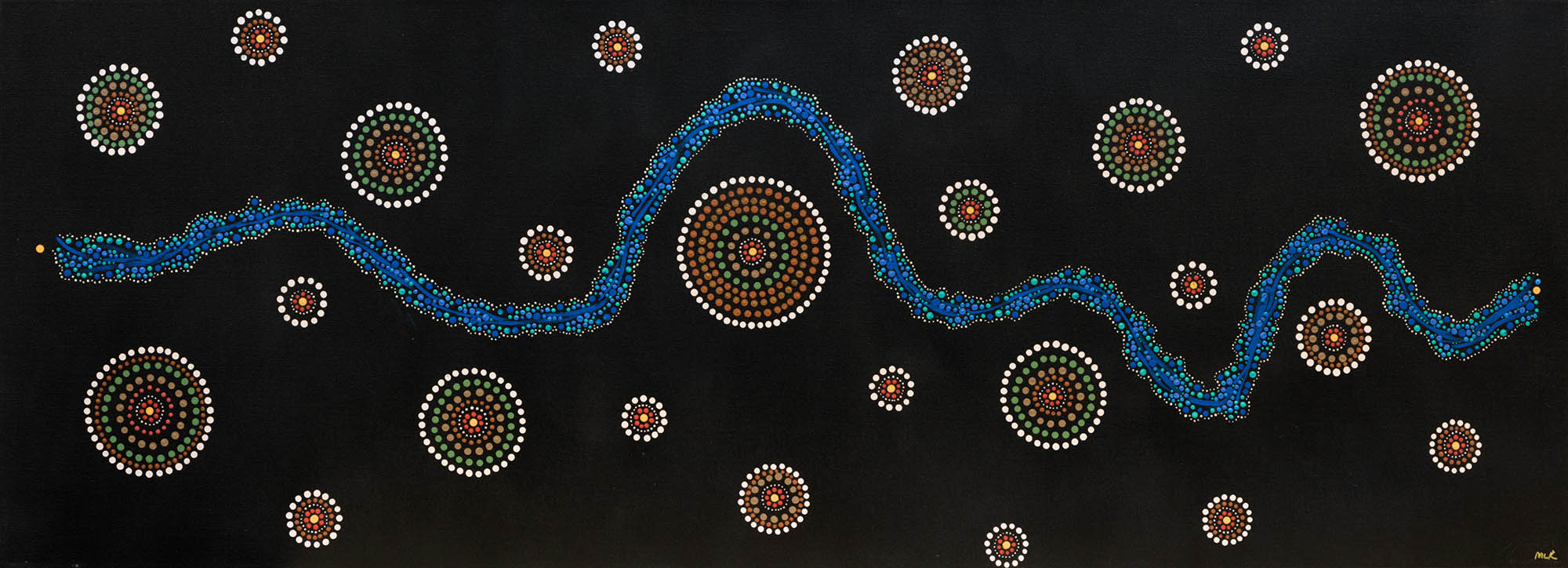
When I went to Oz a few years back, It was the art of 20th century Aboriginal artists that shook me from a long slumber. It freed me from a deep sense of burnout. The power of these artists is to use the absence of form, or the use of forms that seem to resemble the dream-visions on the inside of your eyelids. They informed me that I was seeing the world in a blinkered, back-to-front sort of way.
The music of John Adams seems to hint at something beyond the postmodern. When I heard it at the BBC Proms, I felt for the first time the sense that the simulacrum can be broken, there can be a return to something grand and poetic and exciting: not as a conservative retreading but as a bold new sound.
and Mario, being alone and only fourteen and largely clueless about anti-stem defensive strategies outside T-stations, had had no one worldly or adult along with him there to explain to him why the request of men with outstretched hands for a simple handshake or High Five shouldn’t automatically be honored and granted, and Mario had extended his clawlike hand and touched and heartily shaken Loach’s own fuliginous hand, which led through a convoluted but kind of heartwarming and faith-reaffirming series of circumstances to B. Loach, even w/o an official B.A., being given an Asst. Trainer’s job at E.T.A.
—Infinite Jest—David Foster Wallace
For all that IJ is indeed a kind of literary circlejerk for precocious men in their late twenties, it is nonetheless a useful tool for re-orienting oneself against the draw of entertainment. The book uses its aesthetic charm to trick you into embracing boredom and confusion. This is a good thing.
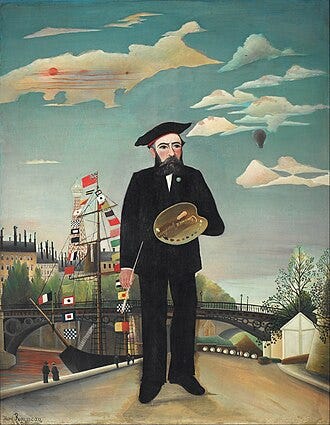
The art of Rousseau is better expressed in his jungle pictures. However, this self portrait hanging in Musée de l’Orangerie. affected me deeply, perhaps more deeply than anything I have seen in a gallery. It is a portrait of a man who never gave up, who trained himself, who made art for its own sake, who steadily worked to free himself from Bureaucratic nonexistence for nine long years.
After all, what can we ever gain in forever looking back and blaming ourselves if our lives have not turned out as we might have wished? The hard reality is. surely. that for the likes of you and me, there is little choice other than to leave our fate, ultimately, in the hands of those great gentlemen at the hub of this world who employ our services. What is the point in worrying oneself too much about what one could or could not have done to control the course one’s life took?
Surely it is enough that the likes of you and me at least try to make a small contribution count for something true and worthy. And if some of us are prepared to sacrifice much in life in order to pursue such aspirations, surely that is in itself, whatever the outcome, cause for pride and contentment.
—Kazuo Ishiguru—The Remains of the Day
The last couple of pages of that book can fix people.
Above all the above, however, I see the variety in the flowers that were previously squished under the category of ‘flowers’. I see the different birds and can recognise some of them. I can see the colours and textures of different lives and different ways of life, each nourishing the other by way of its difference. There is a symphonic harmony in most of everything. Everything except within that black, flat, Chronic cuboid that you are holding, which I held to convey this message to you. I no longer resent that black cuboid; though it cannot be mistaken for existence anymore.
It feels as though I have achieved a second childhood in my late twenties. I literally just learnt how to do backflips! While yes, life demands that I work much harder than a child, and there are far more hardships, there is a fearlessness and vigour that comes only through the removal of simulated experience in favour of the real thing. Baudrillard can eat merde, it is possible to escape the Simulacrum.
If you accept on the basis of this testimony that such an unflattening is possible then you probably want to know about the principles behind that. The next post will be a more focused theory of your time as an exploited commons.
Please subscribe to stay in the loop.
Really enjoyed the depth of your writing. It made me think deeply about many of the points you shared.
Excellent article, Alex
Well done