
Naïveté is a virtue
Or, the startling realisation that most knowledge is subconscious.

Hurtling toward the trampoline, my grown-up, sensible mind is telling me to back down. "That way is painful," it says, "when have you ever managed to do something like that without hurting yourself"—I try to silence it with a huff of my breath, although it's true—I haven't done something like that without hurting myself... "Remember when you came home from school crying because you were the kid who couldn't do a forward roll..." No, enough of that. I am learning that only by ignoring that voice can I be safe from its warnings of sudden doom. If I think, then I get hurt. If I stop thinking, euphoria. One foot grazes the floor in a skip, I leave the floor, flying, flying, landing, not landing. The spongy slackness of the trampoline gives a feeling of falling and floating simultaneously. Hands hit the ground, legs fly almost out of control, and I land... That was almost a handspring. Not quite, but better than my previous attempt. Unprompted and contrary to all conscious reasoning, I am learning. Others can see my progress too and they cheer me on...
I don't know how I found myself in the world of non-competitive adult gymnastics and nor, it seems, do most of the people I do it with. It seems to be an almost illicit impulse that causes people to find a slightly-shady-looking railway arch in East London and do things that they haven't done since they were six-or-seven years old. When they get there, suitably for the sketchy surrounds, they find an addiction—a rush like no other form of exercise. I suppose that it is the rush that comes from experiencing the development of self-knowledge in real time. You cannot reason on it, you cannot really analyse in words what it is that you are learning, but you are learning. Every time you get slightly closer to a new skill, every time you feel yourself flying, in the process of wiring new reflexes you didn't know you could have, you feel euphoric—like your whole nervous system is fizzing with new connections.
The people help. A diverse bunch unified by that same impulse. Sometimes they try and intellectualise their reasons for coming, try, like my conscious mind in the example above, to talk about something something body-issues, or having done it as teenagers or something. Then they go "ha, nah, nevermind. I'm here because I it seemed... like... kinda childlike and kinda fun."
Childlike. That is the word that everyone comes to. Why must it be childlike? What is the appeal of that? The main association between gymnastics and childhood for most people is with the utterly miserable experience of school PE lessons in padded torture rooms that smell like feet. If it were their actual association that drew them in then it would suggest a perverse kind of sadism. These people do not seem perverse. On the contrary, they tend to skew quite friendly and self-assured. If adults can do these things (and, I heard from an instructor once that they can often learn considerably quicker,) why do you never see grown men spinning cartwheels in public?
I suppose that it is because that wouldn't be very sensible. Of the many things that our culture tends to emphasise, one of the most endemic is the sensible-ness of adults. This is not so much a total aversion to risk but more of a bourgeois attitude that says that any risks we take have to be set against the benefits. Only if the risk of an activity can be quantified and seen to be less than the tangible benefits is that activity considered sensible. In most people's minds, the idea of adult gymnastics is not very sensible: It is not as thorough a cardiovascular workout as going for a run, doesn't build muscle as quickly as the gym (although it is a fabulous way to build calisthenic strength) and incurs a higher risk of injury than most sports except skiing. Skiing is also not very sensible, but gets away with it by being a status thing. Rich people have less need to be sensible than the middle classes, for various reasons.
Sensible people don't try to do fly-springs in their late-twenties because it doesn't make sense. You are more likely to sprain your wrist than prepare yourself for any practical situation you may encounter. I posit though that this is precisely the reason to do it. The sport demands a degree of courage that comes from squishing all thoughts about consequence, it demands a juvenile kind of ignorance. It demands Naïveté.
This got me thinking about creativity and consciousness and the ways in which our current social values distract us from the human core of these things so much of the time.
I've grown up in a world that tells me that things are good if they can be rationalised and bad if they are irrational. To which point, I say "what is the point of art?" How do I explain the stirring within that comes from looking at a Turner? Or make sense of a Van Gogh? How do I explain the strange, ineffable feeling I got when I saw an aboriginal dot painting and it hit me with a profound emotion despite coming from a cultural vernacular I know (astonishingly) little about?
Why is it that an orchestra sounds so much better live? So too with theatre, and especially with dance? More-so than mere fidelity I think it has to do with the intractable parts of being real—the sounds of creaking floorboards and shoes, the coughs from the audience, the lengthy periods of nothing that can happen on a live stage while busy hands change things around behind the curtain. There is no intelligible reason why these things bring immense pleasure, they just do.
So too in life as in art, the present mind finds unintelligible resonance in all sorts of places—in the elegant orchestration of the forest, the ambient techno of the city, the unintentional lyricism of people's half formed thoughts; points of view, like photographs, which catch the light briefly before fading forever from view.
What I am realising, through the stimulus of my almost-gymnastics, is that much knowledge, or maybe even most knowledge is not known, it is felt. The whole nervous system is alive with thoughts of varying levels of sophistication. Far from being at the top of Aristotle's hierarchy of sentience, we are simultaneously living across all levels of it—as higher and lower creatures both. With the consciousness of an amoeboid and that of something else; with that of a dog and of something else; with that of a chimp and of something else. Our conscious wisdom is but one part of a recursive tree of conscious experience—some of it our own and the rest genetic.
Even skills we would typically think of as 'intelligent' are at least partially beyond this pale. In addition to wonky round-offs, I am also figuring out how to build a software application and reaching the point where I can no longer possibly keep a conscious record of all of the moving parts in the system. When I was reorganising the source files the other day, I couldn't think of a sensible way to do it that would cover all bases. I couldn't represent the model of it I had in my head in terms of files and folders. My unconscious map of the system is far more nuanced than any I can articulate in any diagram or design documentation, whichever way I did it felt reductionist. However, when I work on the app I can see what the likely consequences of a change will be and see the structure of the system evolve in my head as I make those changes. Of all the cogs turning in my brain, the chain of reasoning that gives me the rational answers to my problems are but a small part.
When I realised this, I felt freed. Us programmers tend to avoid complexity where we can but this can sometimes lead to a sort of inertia where we don't want to tackle problems that will necessarily have somewhat complex solutions (particularly on the first try). I realised that if I stopped thinking about the consequences too much I could build something that mostly works now and tidy it up it later, allowing myself to make something slightly suboptimal that works rather than sitting on a cleanly polished, well organised thing that doesn't do what it is supposed to.
If a large part of one's learnt knowledge is not reason and is not even reasonable, then the idea that you should only prefer to do things that have articulated benefits becomes (ironically) absurd. On the contrary, in many cases, it feels like joy and skill both come from the freedom of being able to act without the constraints of sense. Naïveté is, to some extents, a virtue. Reason can give you a nudge, it can help you figure out what you need to do when you get stuck—but it is one small faculty in the whole tree of sentience that resides within us.
I'll leave you with a moment of resonance I found in a surprising place. As I engaged in the postmodern pastime of watching a Michelin-starred chef cook something nice while I reheat yesterday's leftovers, I heard something remarkable. Midway through skewering a non-orthodox souvlaki, maniacal alchemist/chef Heston Blumenthal reached out and grabbed me with his herby, chicken-y hands and said "People think creativity is something you learn. It's not, it is the absence of the fear of failure". You see, creativity is an absence of blockages rather than a skill in itself. It grows in the absence of limits. In addition to fear, the sensible attempt to rationalise the world is another thing that can stand in your way. To actualise your talents, you have to stop trying to make sense of them.
Oh man this is dynamite!!! I'll come back later to comment on specific points but I just wanted to express my spontaneous appreciation of this piece: it is absolutely superb in form and content! Thank you and bravo! 👏👏👏
Hi Alexander,
Sorry it took me longer than I expected to be able to come back here and comment more precisely.
There are many aspects of your article I enjoyed thoroughly, starting with the first paragraph describing your experience of learning the trampoline at an age where body mass no longer makes even a not-so-nasty crash possibly quite nasty. In fact, the thought crossed my mind: "What a fantastic idea. I'd love to give it a go!"
I had no idea where your article was going from that point when, reading on, I found myself vehemently recognizing and agreeing with your reaction to aboriginal Australian art (and to Van Gogh's as well) and your questioning of the value of art within the prevailing cultural norms of rationality and reasonableness.
But I guess what prompted me to want to comment is that you then went into an area that is of special interest to me at the moment and which concerns the difference between "full spectrum" bodily experience of the material world and the experience of a digitalized representation of the material world, mostly through a screen.
Your paragraph starting with the sentence: "What I am realising, through the stimulus of my almost-gymnastics, is that much knowledge, or maybe even most knowledge is not known, it is felt. The whole nervous system is alive with thoughts of varying levels of sophistication..." touches to something that is formidably important in this day and age where our experience of the world looks like it is going to be almost entirely mediated through technology. The fact that we are complex physical bodies that have evolved through millions of years cannot simply be discarded "to exist almost entirely online", much less to make "intelligent" machines that will function like us, but much more efficiently, much more rationally. Not so sure about much more reasonably, though - arguably the greatest ever existential risk to face humanity.
As an artist, I've come to realize that art cannot exist online where it is falsely alluring, standardized, homogenized, commodified, transient, in short turned into worthless shit. The only artwork that exists is the physical picture on the wall, made by my hand, painstakingly over weeks, months, years (and yeah, pixels are not paint and never will be – even though, as a photographer, pixels are my base material which means: “I have a huge problem!”)
It is very interesting that you should find, as a computer programmer, that mere rational functioning doesn't cover all the bases. This, to me, points to the disconnect between analogue and digital and the gap that must be bridged. It makes great sense that a process of iterative testing helps to make the software do what it is supposed to do in real life. The question is: "Can the gap ever be bridged fully? Is something lost in the process and if so, what is it that is lost?"
Your article is great in pointing to a whole plane of experience that is purely physical and subconscious. Lots to think about here!
And yes, absolutely, fear is the artist's greatest enemy. Fear is the lack of courage (to the point of mortal paralysis) that comes when naïveté wanes, when we try to do art “sensibly”, that is, mostly, to live from it (though it could be said that Heston Blumenthal may have benefited from some amount of fear(!)) Your sentence: “You see, creativity is an absence of blockages rather than a skill in itself. It grows in the absence of limits.” This is so profoundly and importantly true!
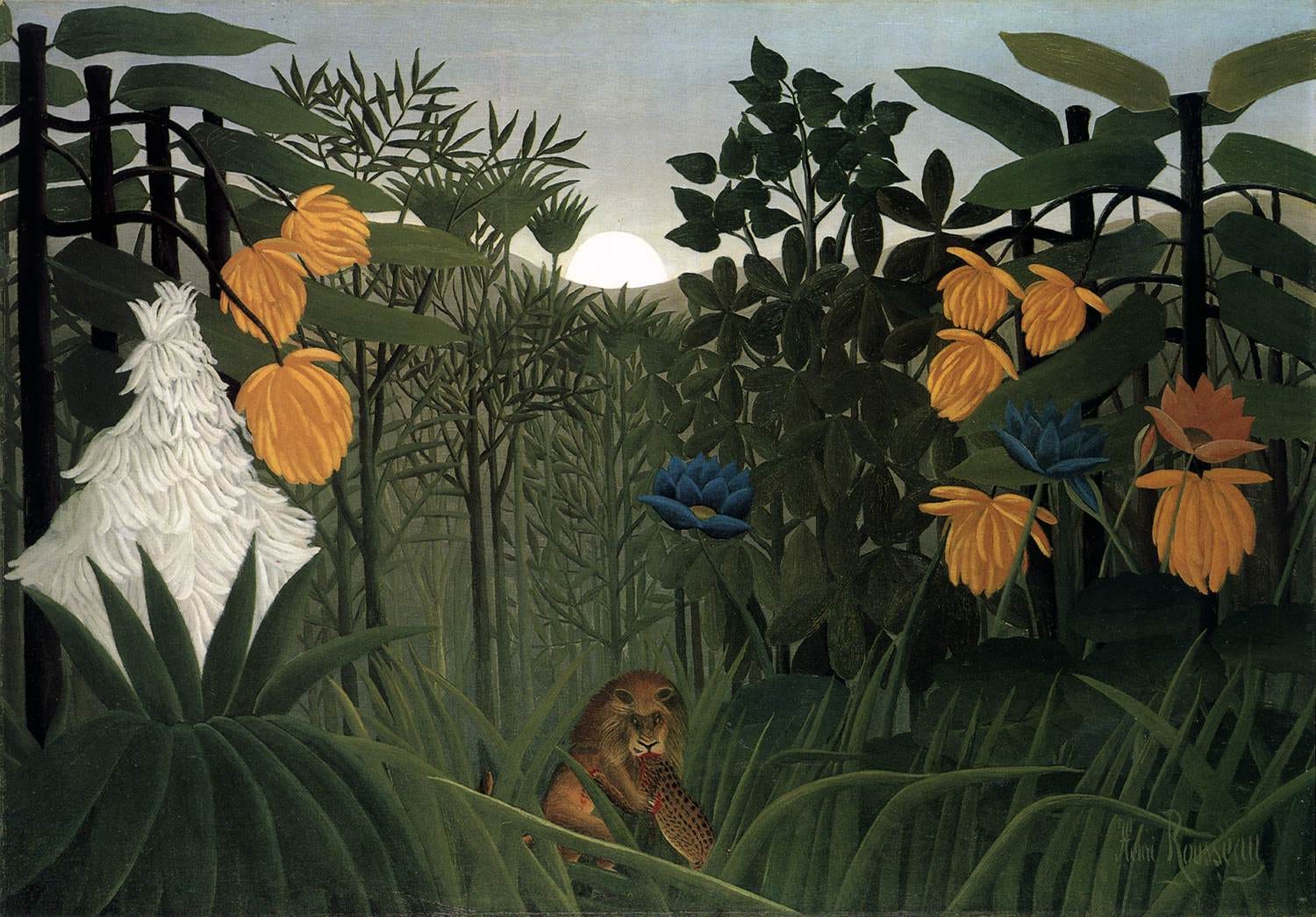
Finally, your Douanier Rousseau illustration is so appropriate and so very beautiful. He was an artist who pursued his passion with total naïveté and perfect sincerity. I find his work immensely beautiful and touching and so enjoyed finding it here.