
Thinking, Fast and Slow
Meditations on Vibe-Coding, touching grass and intellectual labour

Within a single week, I wrote an app.
In the same week, I also had a pleasant Easter with family, spent time lounging in the park reading short stories by Ursula K. Le Guinn, bought some new threads, got everything together for my upcoming holiday and found the time to write this post.
Contrary to the image of the burned-out software engineer, I have been able to do all of this quite comfortably, with most of my sanity intact. Indeed, I’ve managed to go about it in a relaxed, dignified, almost Victorian fashion.
—I even found the time to hand-draw the logo. Drawn, as in drawn with my actual human hand—for there is a certain right-brained chuckling glee that comes from slapping hand-drawn art onto the products of a machine super-intelligence that can’t draw for shit. It’s a similar joy to spray-painting phalluses onto those delivery robots they have in Milton Keynes. (Not saying I’ve done that, only that the thought has crossed my mind, jail me for thoughtvandalism)
The gentle pace was partially imposed by the fact that Anthropic recently tightened usage limits, giving me frequent 2-3 hour breaks when I ran out of Claude tokens, at which point the choice was between actually making sense of the deluge of post-human word-vomit I had just unleashed or going out to touch grass. Since spending too long at my computer makes me feel itchy and wrong, plenty of grass was touched, caressed, cartwheeled, rolled-around-upon, sniffled, sneezed-upon…
Oh yes… the app!
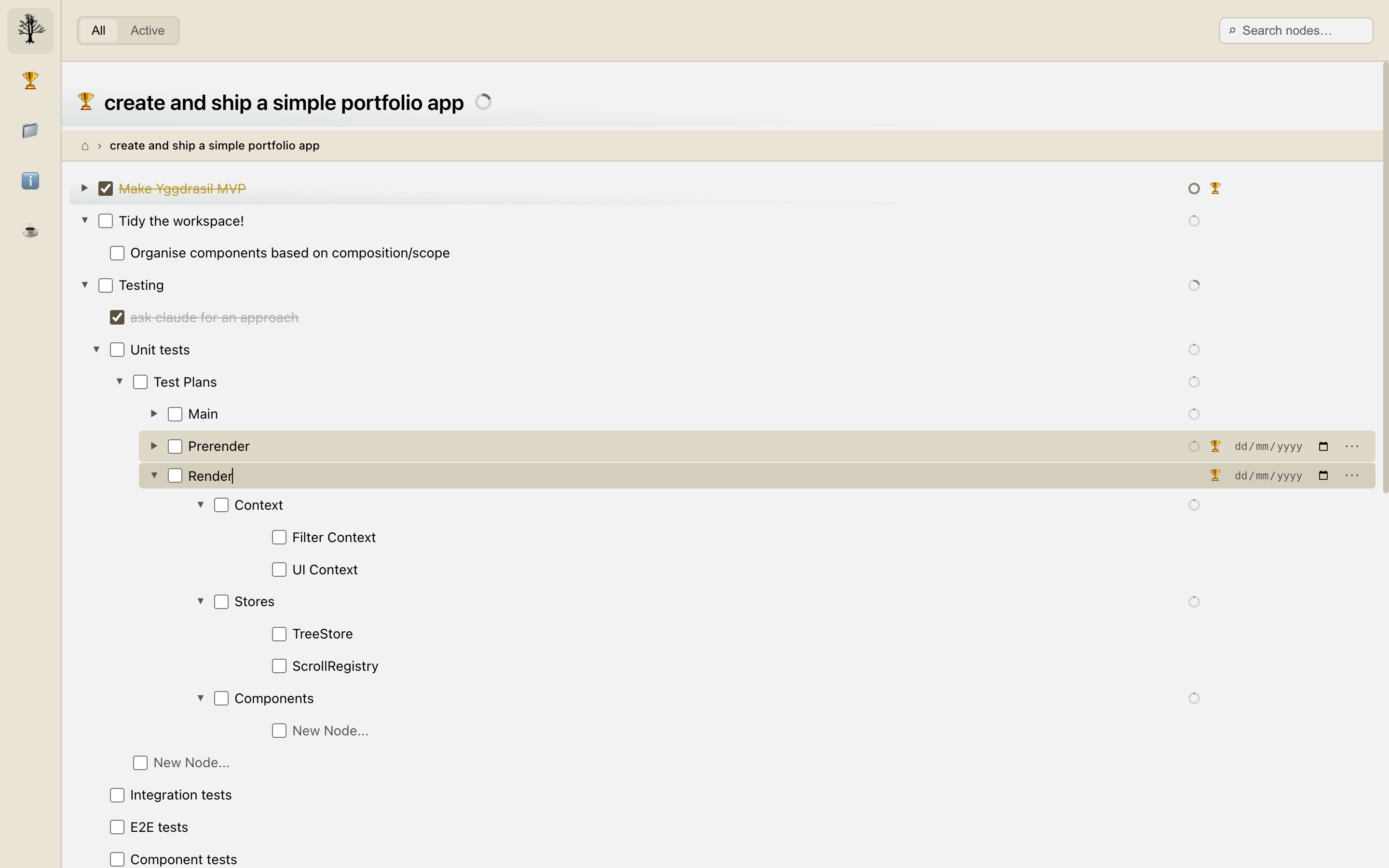
The app is called Yggdrasil, it represents projects as infinitely nest-able trees, so that you can drill down from any big idea as deep as you need to go to get to something actionable. I am already using this tool to manage the large number of projects I have on the go at any one time.
It currently looks like this:
From the perspective of conventional time management, Yggdrasil is utterly perverse. Project management software is normally designed by-and-for managers and executives: whose goal it is to flatten the complexities of reality into charts, calendars, actions and slide-decks. This is so that they can give convenient answers to the board and give orders that their subordinates will follow without asking too many questions. Compartmentalisation is an important part of teamwork, it is also why you shouldn’t endeavour to shape your entire life around your membership of the team, since it does away with the need for philosophy and the possibility of acquiring the circumspection that gives rise to wisdom.
Furthermore, if you actually like making stuff, the industry has some intrinsic worth: knuckling down and doing the work is never really the bottleneck, deciding what work to prioritise is what is really at issue. Understanding what would be involved in each task, the relative difficulty and ROI of different approaches. This is where the friction actually arises.
I had the idea for this app while I was working on a pre-seed, pre-revenue, pre-product, pre-idea startup ;P with a friend of mine, but we didn’t pursue this particular avenue because it was hard to monetise since it is hard to sell to business customers, by virtue of its individualistic kind of logic (the whole idea requires a creative person’s willingness to be selfish in the use of time). Yet, the idea stuck with me as the one thing from that discovery process that definitely ought to exist.
Not only that, it emerged as the one thing that I ought to make even if it did already exist. I wanted to have a version of this idea whose implementation was entirely my own; that I could tweak to suit my exact needs; for it allows me to do more cool stuff with the time I have available, which dwindles with every passing year.
You see, what struck me then and continues to strike me now is that a great deal of what is wrong in the world comes from the attempt to flatten the complexity of the things into a linear series of events. This may seem to be just a convenience, but really it is a performance. It is part of an artificially constructed perception of time which rejects the great—painful—breadth of possibilities that are manifest in the course of a human life. They suppose the past is the only way things could have turned out (because it saves them from regret) and that the future is predestined (which protects them from further regret,) this is not true at all. The past is one of a great many possibilities and the future is too. Besides, as Kierkegaard pointed out, regret is an inevitable and unavoidable part of life; an emotion to be processed and moved past, like ennui, nostalgia, or shame about things you said in high-school. The linear perception of time is a social malaise, a bourgeois fiction, an attempt to efface the essential agony of existence through the science of management.
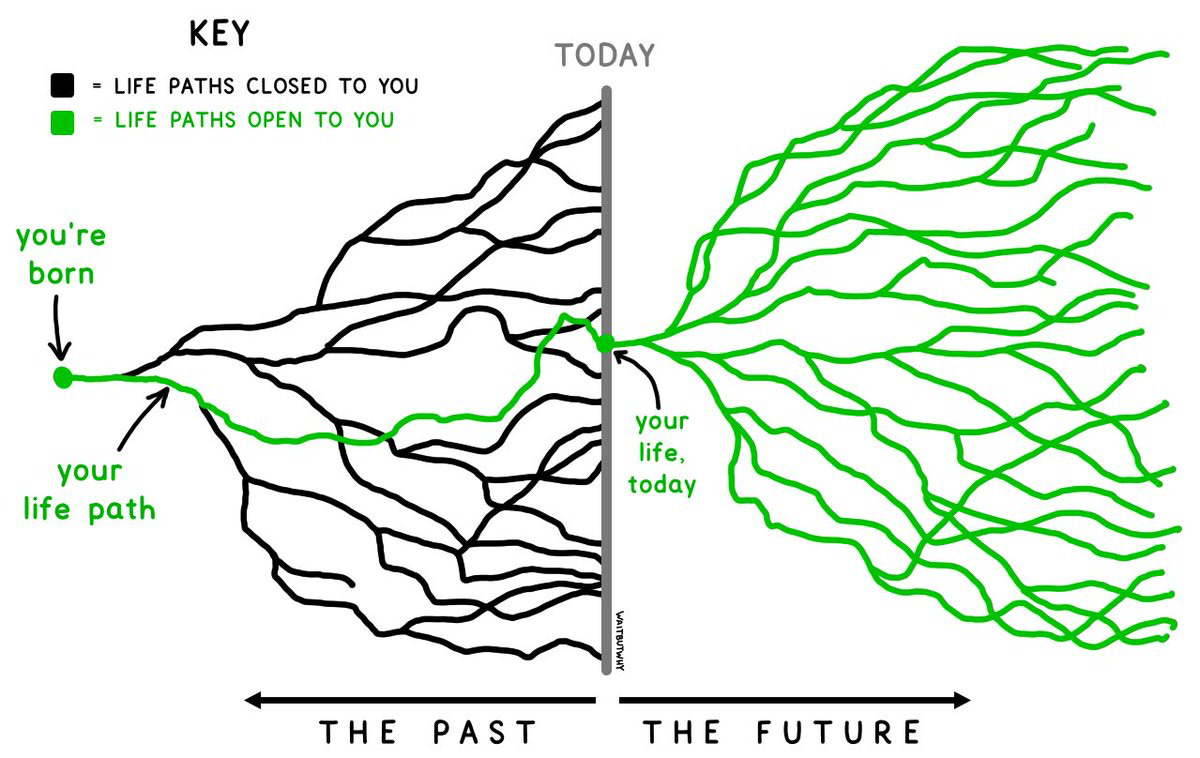
To flatten and ignore is only necessary if what you are doing is meaningless. If what you are doing is worthwhile then committing to a course is easy and the rest falls away as noise. As Nietzsche said: “He who has a why can bear almost any how”.
For people who are awake, the problem is not really one of time management, it is one of selection. There is a value in seeing the pathways laid out, and seeing how far along you would like to walk each of them. If I were to lay one criticism of the above diagram it is that the future is not something that draws from a singular present moment to blossom into a single tree. It is rather more like a garden of shrubberies, with the ability to only tend to one of the plants at a time. All of them will wither and die eventually, these shrubs in the garden of life, but it is up to you to choose which ones to keep in bloom while you can.
To take better care of my garden, I decided to make a tool which could not be made in a commercial setting: one which does not try to narrow one’s mind but instead presents one with as much complexity as one needs, so that it is possible to make informed, authorial decisions about one’s own life and the direction it is heading.
And I used AI to do it.
AI is an easy to technology to denigrate and there are a great many sins involved in its development. The same was true of automobiles and microwaves and yet you are probably quite happy banking the labour-savings that those have given us, Horses and hamsters be damned!
Whatever your grand social criticisms may be, the fact is that AI allows you to make things, like Yggdrasil, that do not make commercial sense, but are of personal value.
For my part I barely know a lick of TypeScript and I hate writing front-end systems. Had I done it myself, I would have used the simplest possible toolset and taken several months. With the help of AI, I was able to use React.JS with electron (complex, production-ready tools) to make something that is sufficient for my personal use-case within a week, that will be distributable within about a month. This project was full of things that I am not good at, it had no commercial justification and no budget. This was something I felt ought to exist but would have been difficult to make just six months ago. It is now built, in action, actively making my life better. Allowing me to work on bigger things that mean even more to me.
If I can make something that works, as an unskilled, un-credentialed person in one week with an £18 Claude subscription, (between having a day job and a life,) imagine what a team of people working full-time for a year could achieve?
AI allows creative, un-optimised people to engineer complex systems that actually work. Indeed, the less optimised you are, the better, since you can steer the machine from the widest possible frame of reference. The age of the nerds is ending, the age of the vibes is beginning. This fact alone has immense revolutionary potential.
… Only… and here is the catch. This only happens as the consequence of a deeply un-optimised process, a steady cumulation over the course of a year, five years; of ruminating, pondering, procrastinating and dithering. Of discovering that which nags you when you try to go to sleep, of that possibility which you cannot process as regret. Of waiting around to Remember which ideas were still worth pursuing.
This is the role of humans in the age that is dawning now. To be the slow and steady voice, tuned in to emotions and into the power of something higher: who wander, who bicker, who do all kinds of small and big things and make mistakes: to go around being human, to identify what is really worth doing.
Behind any moment of prolific output is several years of the above. And there is no way to do it any quicker—except to do less with your time, if you can find the time to do so. Hopefully that will be easier for me now that I have Yggdrasil.
Nice article. Well done
Lovely article. Well done