
You can literally just F— off.

Grab your keys and your wallet and go. Take everything you need except your phone, your watch or any other kind of information device.
Become unreachable, become a ghost. Cease to exist as a bunch of 1s and 0s for a few hours and revert to your pre-2012 state. Become an un-augmented mammal for a bit—while you still can.
Go somewhere interesting or go nowhere in particular. It doesn’t really matter. The point is to just hang out and exist in the absence of most of the penetrative external signal that assaults you daily. The first step to finding your innermost voice is reducing the volume of the loudest external voices.
You didn’t evolve to be aware of every bad thing happening in the world right as it hits the news-wire; nor did you evolve an ability to take on endless marketing messages or doomscrolling feeds or podcasts; or even to listen to infinite live-streams of music. You certainly didn’t evolve to send timely responses to a multitude of emails. Even when you don’t respond to it, the buzz in your pocket calls out like a siren at sea.
This much was obvious to your grandparents, (Although, one imagines that old people in the 1930s used to complain about “those damn youngsters, rotting their brains with those gosh-darned crystal sets!”;) to their grandparents; to the 300,000 years of grandparents preceding; to the hundreds of millions of years of non-human grandparents preceding them. It was obvious to everyone until about 2002, when the Blackberry came out. It was still obvious to most people until about 2015, when most people had had a smart-phone for a few years. It has only been for the last 10 years or so that it hasn’t been obvious.
You’ve probably even forgotten the terms of the bargain, of how you were seduced. How you were tricked into spending your whole waking life jacked into an infinite nightmare feed! (which is a description that applies equally well to broadcast newsmedia as well as algorithmic media.)
I recall the bargain had something to do with making it easier to keep in touch. To allow you to keep touch with globally distributed friends, to facilitate faster and more responsive communication. To make making and keeping friends easier. To remove a lot of the friction in interpersonal relationships.
Convenience is practically the absence of friction. Friction is the main enemy of capital. Capital optimises for efficiency, which in many cases means the removal of friction. However, in order to get you on board with a new effort to reduce friction (i.e. a technological innovation,) this has to be marketed as convenience, which seems to be a short-term benefit to the consumer. However, this deliberately short-term framing ignores the long term commercial incentives which drive technological change.
Removing Friction is not about reducing the amount of things you need to do, it is about reducing two other things: the amount of downtime between each thing you need to do, and the amount of time it takes to do a thing. The fact that this change can save time in the short run is a cover for the fact that it will increase the amount of stuff you need to do in the long run. It’s the same game that has been played by the forces of capital since the very first Industrial Revolution. “Oh trust me, these steam engines will make life easier for everyone—its not like we are going to force armies of children to handle dangerous machinery for 15 hours-a-day, six days-a-week or anything!”—a.k.a. Jevon’s paradox.
This isn’t even the first time it has happened in our lifetimes. I remember hearing my dad and his friends talking like this about email when I was a kid in the early 2000s. People back then thought that the ability to send emails rather than writing actual memos would lead to fewer mixups and speed-up communication, meaning that work gets done quicker. In actual fact, the loss of friction meant that the system invented more work to keep the office drones busy, while giving them the ability to send each-other grumpy, soul-draining emails at 22:30PM. If anything white-collar office life got worse as a result of email, because it removed some of the boundary between home and work. Email didn’t free the salaryman, it just meant that more labour can be extracted from each person with less downtime over a wider range of tasks.
The consequence is that each person ends up with less time to be proactive and follow their calling, since they are spending more and more time having to react to an ever-growing stream of noise.
Aside from not actually making your life any better in the medium-term, (even where the long-term macro-economic gains are real,) the elimination of friction actually makes life more stressful by increasing the number of threads you need to juggle in order to stay afloat. A low-friction life, in terms of the number of processes running in parallel (in a computational sense,) is able to be more complex than a high-friction life. If there is more friction to navigate, you are simply forced to have fewer things going on.
Moreover, when nothing works properly you often find yourself lost or stranded somewhere and forced to actually inhabit your own thoughts, your own intuitions and your own ways of relating to people; which may differ from what you normally consider ‘proper’.

As such, there is worth in sometimes throwing a spanner in the works. Not in such a way that it causes harm or makes people worry about you. Just, sometimes it is good to let things happen a little slower than they absolutely could be. Ask yourself, what difference does it make if I know the news now versus in two hours time?
Put another way, unless you are actively on duty, you can ask yourself what are the odds of A: learning something life-changing in the few hours and B: the odds that you would be able to do something about it in that amount of time, given A?
p(A) is a very small number, unless there is some news that you have been credibly expecting. p(A) * p(B|A) is by definition an even smaller number. Sure, it could happen, but the risk is really quite tiny. Much smaller than the risk you take every-time you get in the car.
It almost feels slightly silly to put it in those terms, because what we are talking about is such a natural and obvious thing. And yet many of my friends track each-other with location sharing and cannot go anywhere without somebody knowing exactly where they are. I am certainly not alone in feeling as though we have become so conditioned to be afraid of missing out, that we seem to think, superstitiously perhaps, that there is a danger in even going to the corner shop without a tracking device in our pocket.
That is why there is a sense in which making yourself unreachable has become a rebellious act. A very small act of rebellion perhaps, one which even sounds a little cringe when couched in those terms. And yet it is precisely the first step to taking bigger acts, because it affords you the opportunity to listen once again to your quiet inner truth, which has perhaps been suppressed for 15 years. To be absent of any inbound signals except for those which occur as part of a coherent nonfragmented environment. Not interrupted with screens, which are like portals to alien dimensions. Unmediated; in some way complete.
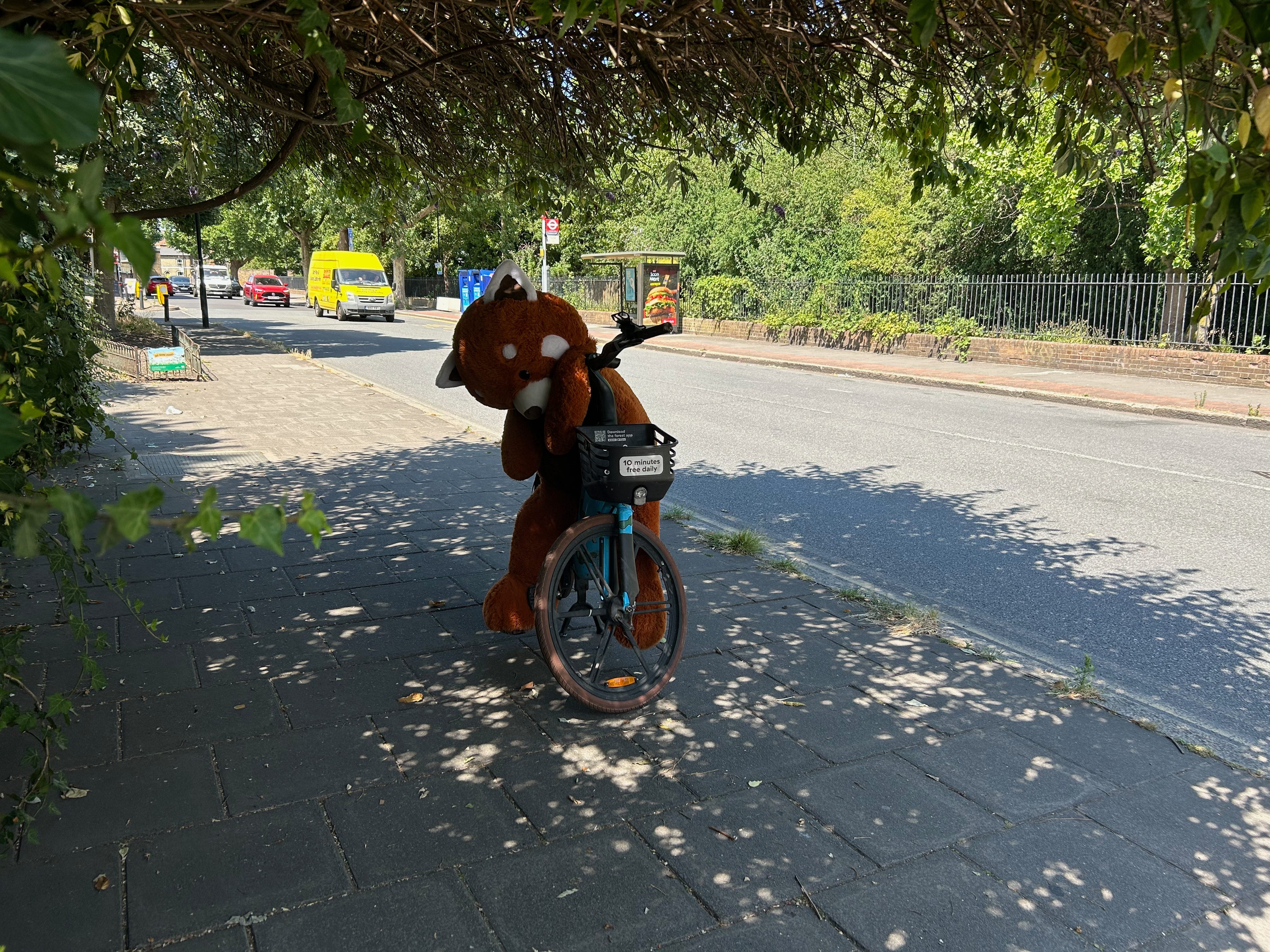
In the absence of those loud external voices clamouring for your attention, many of the strange delusions by which you have been preoccupied are revealed to be ridiculous at the quiet insistence of your innermost self. You pay closer attention to things: which flowers are in season and what insects are currently active. You are also much much more likely to strike up conversations with strangers and meet cute babies and dogs. I’ve also noticed that cats are a lot friendlier. I don’t know if that’s a vibes thing or if they can pick up some hypersonic noise from electrical devices or something—probably the former. The joy of this tiny rebellion is in recognising these small things; precisely because there are no louder, bigger things trying to steal your attention. The monster is at home, buzzing away on your desk.
In that relative quiet, the quiet of real (unmediated) life, you can start thinking again. You can listen to that quiet Whisper from within. You can start to remember who you were and what mattered to you when you were last available to enjoy a moment like this. You are able to re-align yourself towards things that actually matter to you.
You may, ironically, start to find that you actually become more productive.
—Though if that happens, don’t deliver your work too quickly and definitely don’t let your boss catch on!